Wednesday Church: Why the Comic Shop Is Still America’s Best Weird Little Living Room
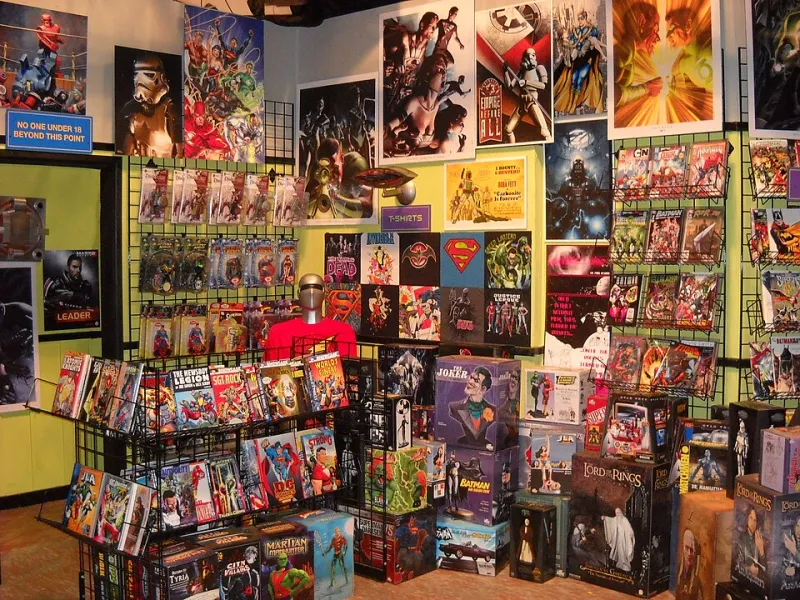
Photo: Chester from Toronto, Canada, CC BY 2.0, via Wikimedia Commons
On a Wednesday afternoon in 2026, the most social room in my neighborhood is a comic shop with a cardboard cutout of a robot near the door and a guy named Marcus explaining, with genuine urgency, why a variant cover is not an investment. The line is not around the block. It is, however, a line. Someone is picking up a pull list. A kid is negotiating for a graphic novel. Two adults are having the kind of argument about a crossover event that would be alarming at a dinner party and is completely normal here.
That is the comic shop’s superpower in 2026: not beating the internet at distribution, but beating your couch at being a place worth leaving. Digital releases are fast. Rent is not. Buying habits have shifted. And yet the shop survives as one of the last great third places—not home, not work, not school, but a room you choose because people there know your weird thing.
The Wednesday Ritual Has Not Gone Anywhere
Wednesday still feels like a small holiday in shops across the US. Maybe the crowd is smaller. Maybe the release-day rush now stretches into a release-day afternoon. But the ritual remains: new comics on the wall, hold boxes behind the counter, staff doing triage on a shipment while a customer asks if the new issue is 'the one where things get bad.' (Yes. It is always the one where things get bad.)
The smart shops have stopped treating Wednesday as a pure sales event and started treating it as a social one. They post pull-list reminders. They set aside copies. They run a folding table with coffee and call it a club. The release-day experience is less about getting the book before anyone else and more about being around people who also have opinions about the book.
The Real Subscription Is the Person Behind the Counter
A pull list is technically a spreadsheet. Emotionally, it is a relationship. The best shop staff remember that you like creepy rural horror but not gore, that you will try a new indie series if the art is weird, and that you have been meaning to read more manga and are lying about it.
That relational knowledge is something an algorithm cannot fake. A recommendation engine can tell you what people bought. A good comic shop can tell you what you will actually like, then hand you the next volume because it is already behind the counter and they saw you looking at it last week.
Shops also remain event spaces by necessity and by instinct: signings, book clubs, trivia nights, kids’ comics workshops, artist alley tables, charity raffles, Free Comic Book Day chaos. Some events are tiny. Some are just five people and a whiteboard. That still counts. A third place does not need a velvet rope. It needs a reason to show up.
The Rent Problem Is Real. The Eulogy Is Premature.
Let’s not do the thing where we pretend everything is fine. It is not all fine. Rising rents are real. Digital releases have changed buying habits. Some shops have slimmed down inventory, moved to smaller spaces, or built online stores to survive. Others have leaned harder into used trades, consignment, memberships, or shared event space. The economics are not cute.
But the narrative that comic shops are doomed is older than most current customers. Shops adapt because they have to. The ones that last are not museums for floppy comics; they are small businesses with taste, community, and a stubborn willingness to order the weird book you asked about.
The competition is not just a download. It is staying home. And the answer to staying home is being a place that feels good to visit.
How to Support Your Shop Without Becoming a Human ATM
You do not have to buy a $40 hardcover every week. You do not have to perform financial loyalty. But there are practical, low-key ways to keep the lights on:
- Buy something on Wednesday if you can. A single issue counts.
- Use your shop for special orders instead of treating it as a showroom for an online cart.
- Join the pull list, then actually pick up the books. Ghost boxes hurt.
- Attend the events, even the small ones. Bring a friend who has never read a comic.
- Buy gift cards for the comics-curious people in your life.
- If money is tight, ask about used trades, library partnerships, or budget-friendly all-ages shelves.
- Say thank you to the staff. Retail is retail. Comics retail is retail with more opinions.
And if your shop is not perfect—if the lighting is bad, the hours are weird, or the manga shelf is a disaster—remember that you are allowed to care about a place without demanding it be flawless.
The Third Place With a Longbox
In 2026, a comic can arrive on your phone in seconds. A community cannot. The shop is where you learn that the person next to you also loves that one cancelled series, where a kid discovers their first favorite artist, where a Wednesday can feel like a small town square with more cardboard.
The last great third place might smell like newsprint and carpet cleaner. It might have a guy named Marcus. It might be holding your books behind the counter right now. Go pick them up.